What Causes Food Noise?
Written by Aimee Gindin
Certified Intuitive Eating Counselor
Have you ever tried to focus on your work or homework, but your brain keeps shouting "Pizza! Chips! Chocolate!"? It feels like a radio in your head that won't turn off. This is often called "food noise." It is that constant, nagging preoccupation with food. It is thinking about what you will eat next, worrying about what you just ate, or obsessing over foods you "shouldn't" have.

Many people think this happens because they lack willpower. They think they are just obsessed with food because they are weak. But that is not true. Science shows us that food noise is actually a natural reaction. It is your body trying to save you. When you understand what causes food noise, you can finally start to lower the volume.
Table of Contents
- Your Body Thinks It Is Starving
- The Brain Chemical That Demands Carbs
- The "Forbidden Fruit" Effect
- The Food Police Are Loud
- How to Turn Down the Volume
- Sources
Your Body Thinks It Is Starving
The biggest cause of food noise is simply not eating enough. In our world, we are often told to diet, count calories, or skip meals to be healthy. But your body does not know you are on a diet. It does not know that there is a grocery store down the street. When you restrict food, your body thinks you are in a famine. It thinks you might starve to death.
To keep you alive, your body turns on powerful survival tools. One of these tools is making you obsessed with food. A famous study called the Minnesota Starvation Experiment showed this clearly. Healthy men were put on a semi-starvation diet. Before the diet, they didn't care much about food. But once they were restricted, they became obsessed. They talked about food constantly, dreamed about food, and even collected recipes.1
"A dieting body is a starving body… As far as the body is concerned it is living in a famine state and adapts."2
If you are hearing loud food noise, it might be your body begging for fuel. You can check if you are physically hungry by using the Intuitive Eating Hunger Scale. This tool helps you figure out if your body needs energy or if something else is going on.
The Brain Chemical That Demands Carbs
There is a biological reason why you might crave bread, pasta, or cookies specifically. When you don't eat enough, your brain produces a chemical called Neuropeptide Y (NPY). This chemical has a special job. It triggers your drive to eat carbohydrates.
Why carbs? Because carbohydrates are your body's favorite source of energy. When you restrict food, NPY levels go up. It screams at you to eat carbs to survive. This isn't you being "bad." It is your biology working exactly how it is supposed to.^3
If you often ignore your hunger in the morning or skip breakfast, your NPY levels can be very high by the afternoon. This can lead to a feeling of being out of control around food later in the day.4 If you are curious about how this differs from other methods, you can read about Intuitive Eating vs. Calorie Counting.
The "Forbidden Fruit" Effect

Another major cause of food noise is psychological deprivation. This means feeling like you can't have something. Think about a toddler. If you put them in a room with a hundred toys and tell them they can play with anything except the red ball, what do they want? They only want the red ball.
Adults are the same way. When you ban a food, it becomes extra special. You start to crave it more. This is called the "Forbidden Fruit" effect.
"The moment you banish a food, it paradoxically builds up a 'craving life' of its own that gets stronger with each diet."5
This leads to something called "Last Supper" eating. This happens when you decide you will start a new diet tomorrow. Suddenly, you feel like you need to eat all the food today because you won't get it later.[^6] This creates a lot of noise in your head as you panic to get the food while you can.
The Food Police Are Loud
Sometimes the noise in your head comes from the "Food Police." These are the thoughts that judge you for what you eat. They say things like, "You were bad for eating that cookie," or "You have to run extra miles to burn off that pizza."
These thoughts create guilt and anxiety. When you feel guilty about eating, you think about food even more. You worry about every bite. This mental chatter takes up a lot of brain space. It is hard to focus on your life when the Food Police are shouting at you.7
If you want to learn more about how to quiet these voices, you might look into our Intuitive Eating Resources. We have guides that can help you challenge these negative thoughts.
How to Turn Down the Volume
The best way to stop food noise is to stop the restriction. You have to convince your body that it is not starving. You have to convince your brain that food is allowed.
- Eat enough food: Make sure you are feeding your body throughout the day.
- Make peace with food: Give yourself unconditional permission to eat what you like. When you know you can eat a cookie anytime, it stops being so exciting.8
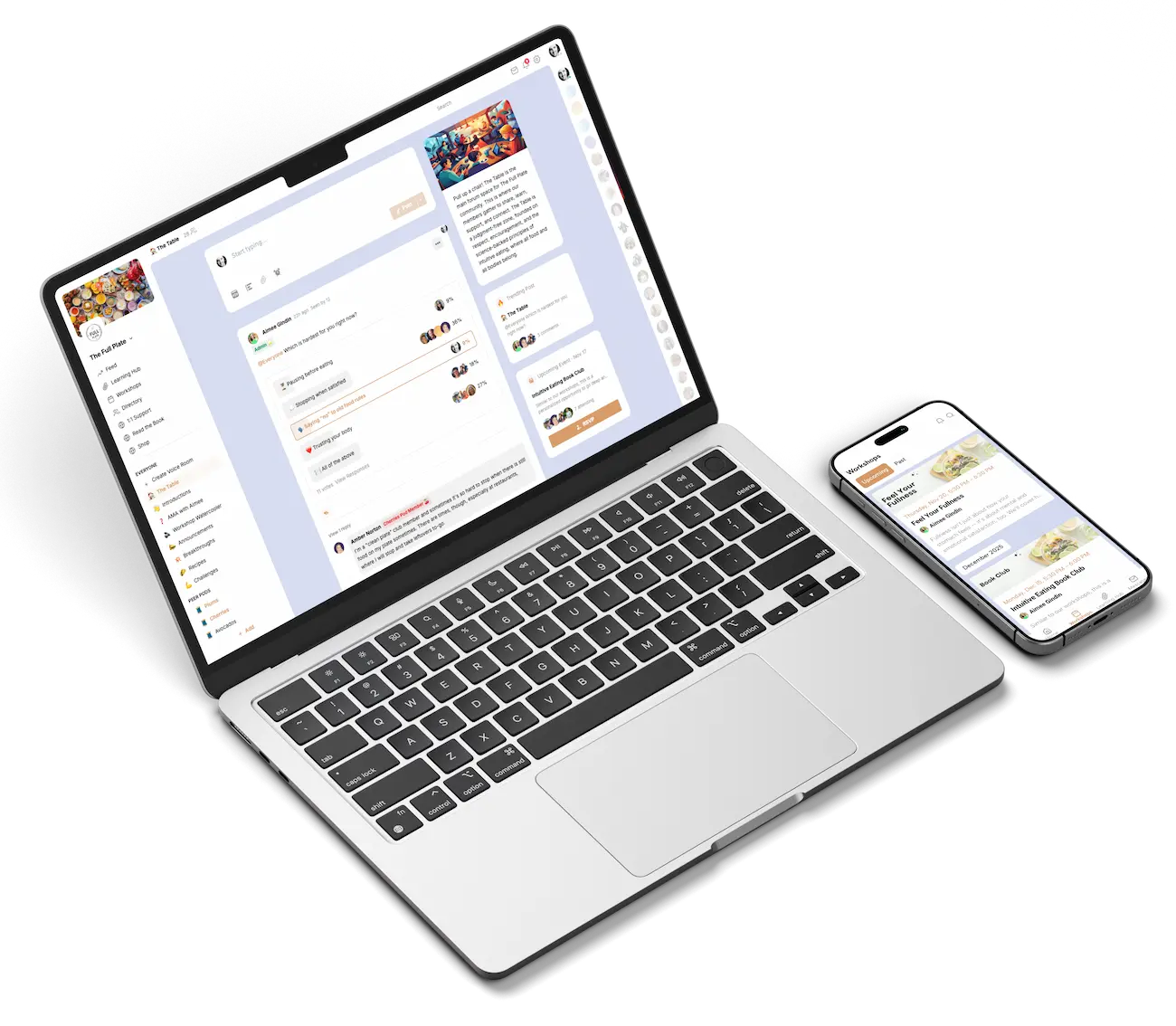
- Seek Support: It can be hard to do this alone. You can find help and friends who understand at The Full Plate Community.
If you are struggling with a specific health condition, you might wonder how this fits in. For example, many people worry about Intuitive Eating and Diabetes, but learning to listen to your body is helpful for everyone.
Quieting food noise takes time. It is a journey of trusting your body again. If you want to dive deeper, you can check out our Intuitive Eating Workshops. And if you just want to get to know us better first, visit our About page.
By feeding your body and being kind to yourself, the radio in your head will eventually stop playing the same song. You will find that food becomes just food, not something to obsess over.
Join our
Intuitive Eating Community
Heal your relationship with food without shame, without rules, and without restrictions.
Join the community
No credit card required
Sources
1: Evelyn Tribole and Elyse Resch, *Intuitive Eating: A Revolutionary Anti-Diet Approach*, 4th ed. (New York: St. Martin’s Essentials, 2020), 113.
2: Tribole and Resch, Intuitive Eating, 112.
3: Tribole and Resch, Intuitive Eating, 117.
4: Tribole and Resch, Intuitive Eating, 117.
5: Tribole and Resch, Intuitive Eating, 133.
6: Tribole and Resch, Intuitive Eating, 135.
7: Tribole and Resch, Intuitive Eating, 152.
8: Tribole and Resch, Intuitive Eating, 142.